Quickstep
Music 50–54 s · 4-second window · 30 fps
Skeleton comparison and supporting views
Duet-Gen · TCDiff++ · Duolando* · PasFlow. * Duolando generates the follower with a ground-truth leader, a different conditioning task.
Music-driven duet dance generation requires both musical alignment and coordination between dancers. PasFlow is a Plan-as-Source flow-matching framework that encodes genre-specific relative orientation priors in its source distribution and pairs source samples with motions from the same relational mode. Its Relation-Guided Spatiotemporal Interaction (RGSI) module predicts relative positions and orientations, using their temporal context to guide feature exchange between dancers. We introduce Relational State Distance (RSD) to compare static joint distributions of partner distance and mutual bearings, pooled across all standard evaluation windows without separating dance genres. Experiments on DD100 demonstrate automatic generation and explicit orientation control, enabling different interaction configurations from the same music.
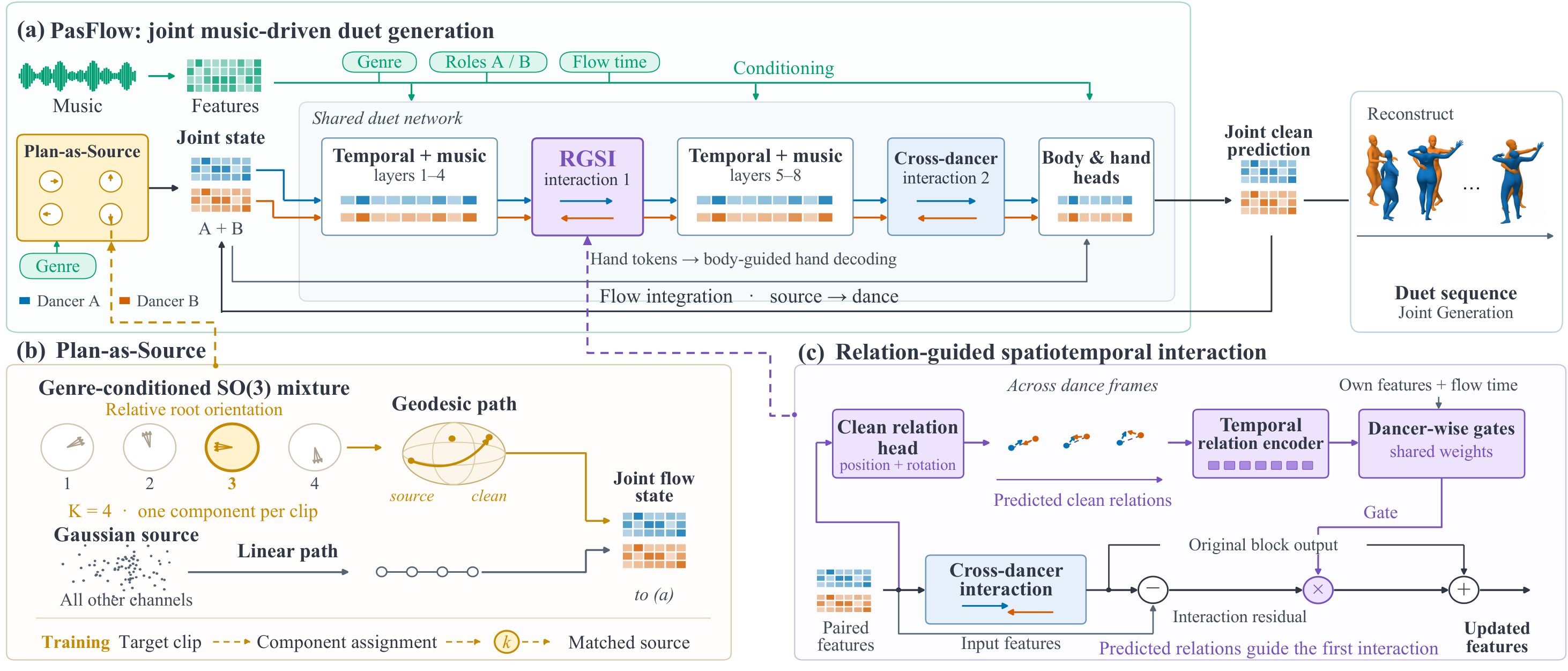
PasFlow jointly generates both dancers from music through flow matching. Plan-as-Source initializes their relative root orientation from a genre-conditioned, four-component SO(3) mixture and pairs training clips with matching source components. RGSI predicts the partners’ relative positions and orientations, encodes how they evolve across dance frames, and uses dancer-wise gates to modulate feature exchange between dancers.
Five dance styles, presented as individual comparisons. Each sample shows a complete four-second window with synchronized methods.
Ground truth · Duet-Gen · TCDiff++ · PasFlow (Ours)
Music 50–54 s · 4-second window · 30 fps
Duet-Gen · TCDiff++ · Duolando* · PasFlow. * Duolando generates the follower with a ground-truth leader, a different conditioning task.
Music 20–24 s · 4-second window · 30 fps
Duet-Gen · TCDiff++ · Duolando* · PasFlow. * Duolando generates the follower with a ground-truth leader, a different conditioning task.
Music 40–44 s · 4-second window · 30 fps
Duet-Gen · TCDiff++ · Duolando* · PasFlow. * Duolando generates the follower with a ground-truth leader, a different conditioning task.
Music 60–64 s · 4-second window · 30 fps
Duet-Gen · TCDiff++ · Duolando* · PasFlow. * Duolando generates the follower with a ground-truth leader, a different conditioning task.
Music 20–24 s · 4-second window · 30 fps
Duet-Gen · TCDiff++ · Duolando* · PasFlow. * Duolando generates the follower with a ground-truth leader, a different conditioning task.
Both dancers are generated by PasFlow, Duet-Gen, and TCDiff++. PasFlow uses music, genre, and role labels; Duet-Gen and TCDiff++ use music. All comparisons use the same view, light, and scale, with the original relative motion retained. Distance curves describe the selected examples; wrist proximity does not establish physical hand contact.